

Improving The Effectiveness Of Your Board
Improving The Effectiveness Of Your Board
How to Choose the Right Person to Succeed You Interestingly most organisations don’t succession plan very well. This probably goes back to the fact that many don’t do thorough risk management. Within a process of evaluating risks the issue of what happens to key staff should loom large. The chance of this happening, the effect of it, plus the proposed solution and who is responsible for carrying it out is essential as part of the risk management process.
This risk management is essential both in owner managed “family” businesses and particularly charities, where all too often the Director of Chief Executive leaves and the Chair is left holding the baby after the notice period has been served and before a new incumbent can be found. This places even more pressure on the recruitment process and the temptation to “cut corners”. In a family business it’s key to be developing family members over a long period of time so that they can build up the knowledge and experience to be a success in the roles they and the owner would want them to do. It’s also essential that they are supported by the right cadre of senior staff to make their appointment a success.
Risk management should be part of the “Management Review” system that is built into the processes and procedures that determine the operation of the enterprise. So the key to start with in succession planning must be to have evaluated the risks to the enterprise of key staff leaving and have a plan in place both temporary and long term to manage it. Both the Chair and The Chief Executive should discuss this at regular intervals to determine strategy.
When a key member of staff leaves it’s not always straightforward that the individual is replaced by a “clone”. It could be an opportunity to change the management structure or bring in someone with a different set of skills and approaches that will help develop the enterprise strategically. Aligning the recruitment to strategic direction is key. “Buggins’ turn” or promoting from within or grabbing someone quickly from outside will not do.
The 9 Keys to Effective Succession Planning
1. Have key staff positions as an integral part of the risk management process
2. Evaluate and quantify the risks of losing key staff
3. Have a plan in place to deal with those risks that is in alignment with the strategy of the enterprise
4. Structure times to regularly review the plan
5. If it happens take the time and effort to manage the recruitment (or promotion) process properly
6. Make sure that the definition of the role and the experience and personality of the person to do that role aligns with the strategy
7. Use external help or opinion to test and evaluate your thoughts and approach
8. Consider restructuring your team as part of the process. A person leaving can be an opportunity not only a threat.
9. Make sure that the person recruited fits the dynamic of the team and the way you want the team to develop.
Open Sesame – SME success for South East Business
My latest blog on the DMH Stallard “SME Rocket” is about a small business in Surrey with an innovative solution to help those confined to a wheelchair.
You can find the story here
http://smerocket.net/2014/10/09/sme-success-southeast-business/
Looking after the interests of the South East
My latest article in South East Business Magazine looking at the aftermath of the Scottish Referendum and the impact on the South East of England
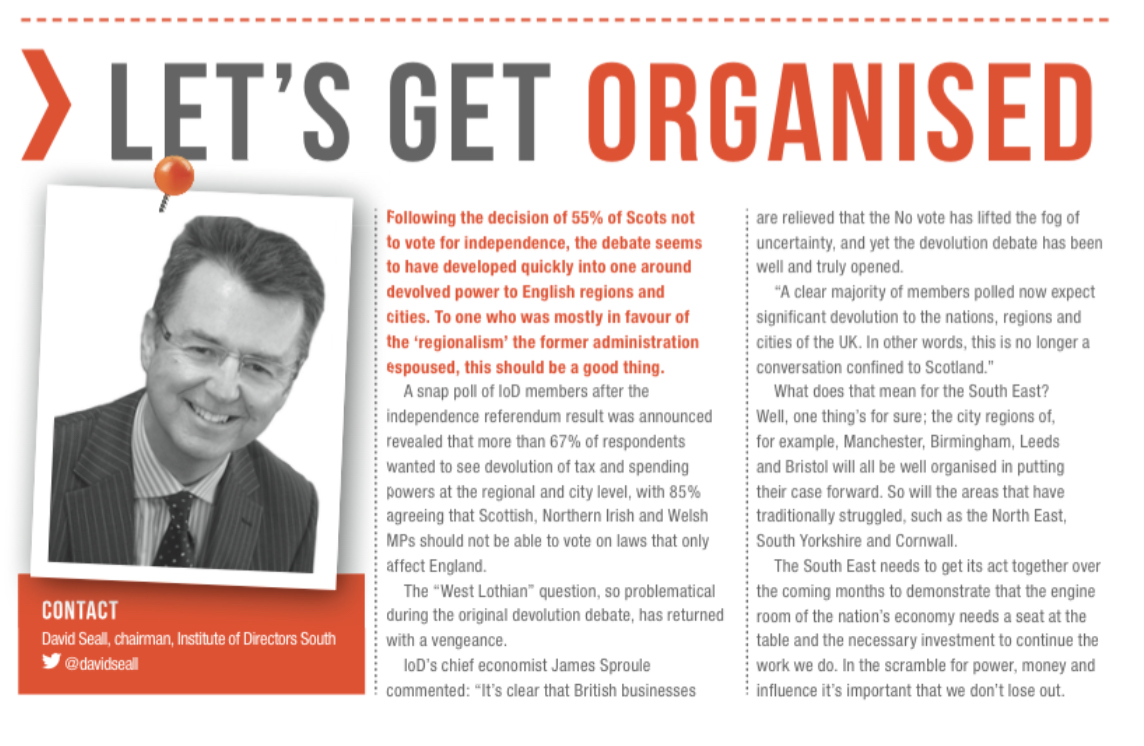
The article and full magazine can be found here http://www.southeastbusiness.com/print-edition/october-2014
IoD South East Director of the Year awards
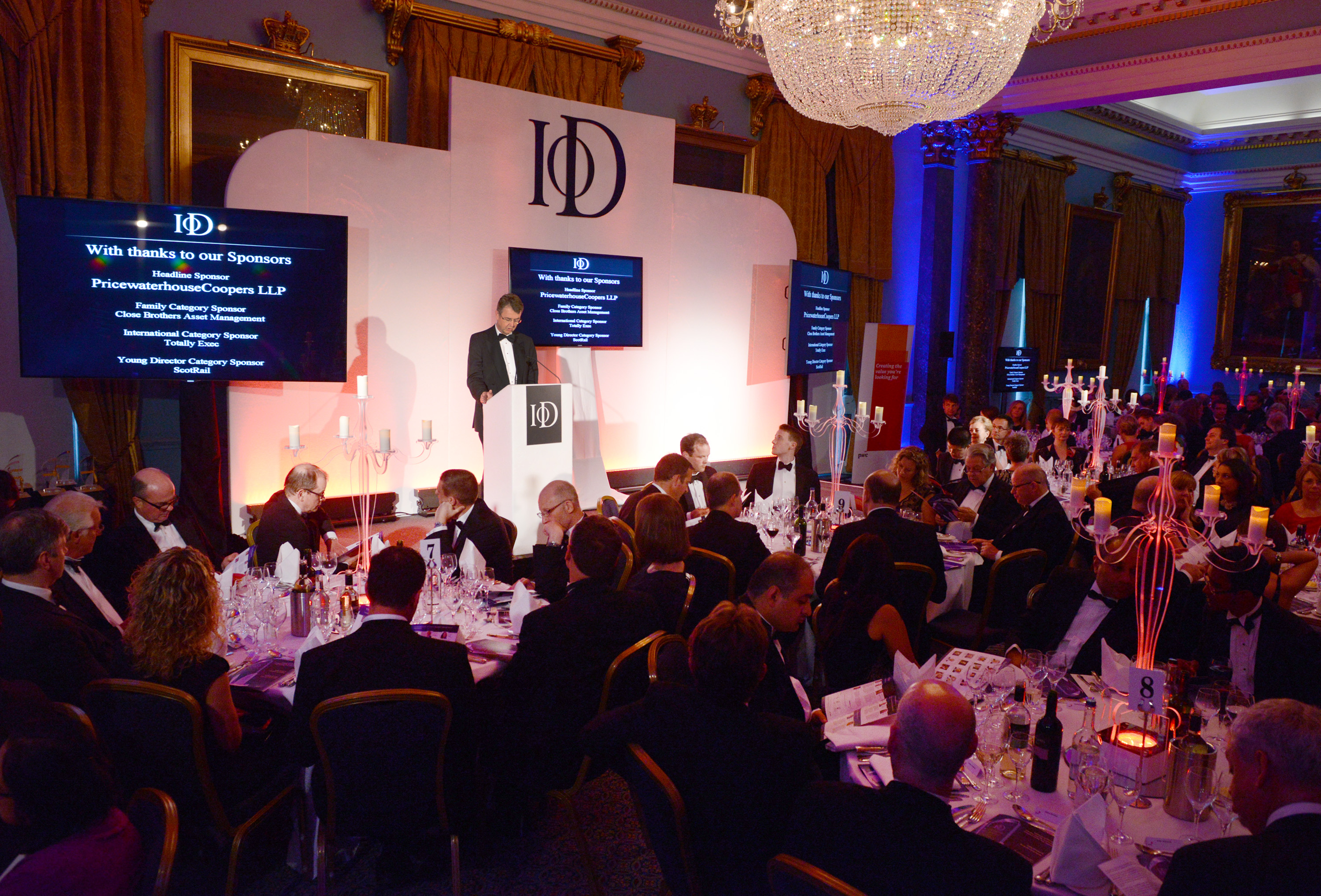
Nominations are now open for the IOD Director of the year awards for the South East.
The finalists will enjoy attending a marvellous dinner similar to the one we held at Pall Mall back in the summer. Lets hope that we get to see the best in business leadership again
You can enter here http://iod-awards.co.uk/Index.aspx
Interviewing key business figures
I seem to have created some sort of career interviewing people!
I have interviewed Charles Morgan former CEO of Morgan Cars and Stuart Garner CEO of Norton Motorcycles in front of a live audience at the Knowledge Peers Conferences at the Sadlers Wells Theatre in London. Both of them are passionate about British Manufacturing and the products that they make.
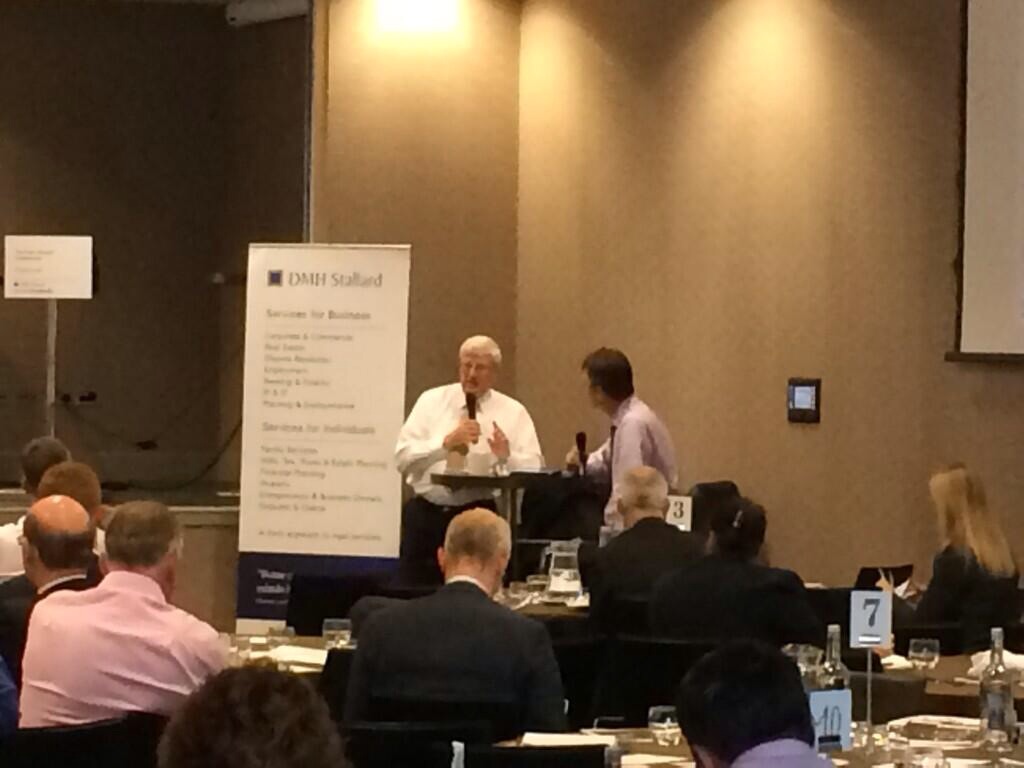
Here, I’m interviewing David Hodge the Leader of Surrey County Council for the DMH Stallard #fastgrowth event in Guildford during the summer. David was great at stirring up the audience and flying the flag for Surrey and the South East.
Notes from the Farnborough Air Show
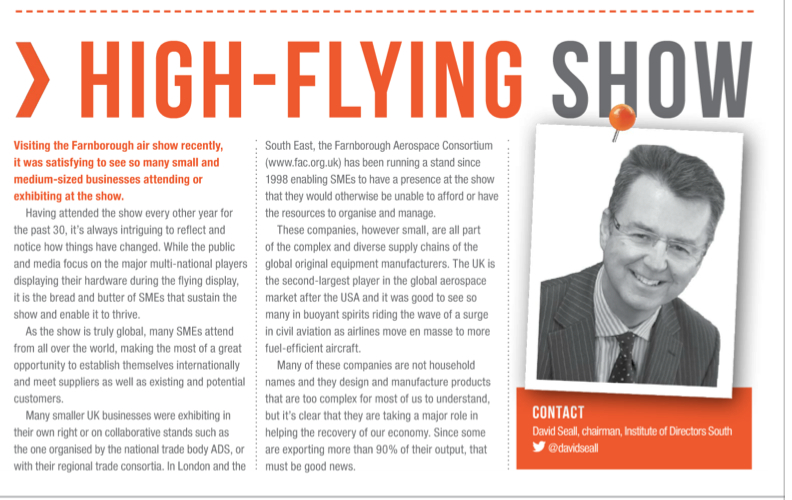
My latest article in South East Business Magazine
The full article can be found here http://www.southeastbusiness.com/print-edition/september-2014
Promoting the three “P”s within IoD in the South East
It’s a great honour to have been selected to be the Regional Chairman and I’m busy now getting on with the challenge.
I will be making a point of getting out to branches during the year and seeing how branches are engaging with members and delivering events and activities. I’m keen to explore three main topics of interest during my Chairmanship, the thing that springs to mind with is is the three “p”s.
The first of these is promoting the “best Practice” of branches and promulgating these across the region. Although members are able to go to any event they want to, regardless of which branch they are members of, I’ll be looking to explore which events and programmes really work well and whether they can be run by all or most of the branches to improve the value to members across the region. We will also be working more closely with the London branches to make these more coordinated with our region as I know many of you are in London during the working day. London acts a focal point for us and is an easy place to travel to.
The second strand is one of improving our impact on Policy matters. The present government has moved activities from a regional to a more “local” level. Although we could argue that some of the “local” levels are almost the same size as some old regions and that Westminster still has a big hold on things. We will be comparing what branches are doing on the local policy front and encouraging engagement and also looking at what impact we can make if we work more closely together. We all know that the South has major issues with things like infrastructure, affordable housing and skills so we will be looking to make an impact in those and other areas.
The final area we will be working on is to “Punch our weight” with major stakeholders in a more joined up way. This may either be to obtain sponsorship for events across the region, promote regional/national initiatives that will benefit members or do more “combination” activities where branches work together. To me the IoD is about promoting the best standards in leadership to its members. We can do this at branch level by providing events and programmes that provide information or learning experiences that encourage a development of leadership skills and entrepreneurship.
It’s a hugely and enjoyable role to have and I’m enjoying working with the branch Chairman across the region to see how we can make a difference and help businesses of all sizes thrive and grow.
How do you implement performance management in an SME?
An issue that often isn’t grasped by organisations is the one of performance management. Too often, those in the organisation that fail to perform adequately, are seen to be seemingly ignored by management. Their poor performance is allowed to continue. They are often “carried” by the rest of their team, or worse, moved into roles that are undemanding or even specially organised for them. This can seriously affect the morale of a team, as “carrying” an individual usually means extra work for the rest of the team and generally, poisons the workplace. When working in unionised environments, I’ve been asked on occasion by union representatives, why a colleague (usually a union member), hasn’t been dealt with by weak middle management.
I’ve heard the performance management system in one large company described by the HR Director as the “bedrock” on which the company is built. In a large corporate structure there is usually an HR system that deals with staff performance which means that it’s difficult for poor performers to remain invisible for long. Moving leadership around so that appraisals are not always by the same person or individuals being placed in integrated project teams, usually shows up poor performance. A person who may be “flavour of the month” for one manager may not be seen as that by another.
A well run appraisal system, which is reviewed by HR and senior managers, gives an indication of something being amiss. If this happens there are well documented processes and procedures for managers to use that should produce the necessary corrective actions to improve performance. Sometimes managers are encouraged to discuss the results of their appraisals with their peers in the team so that ratings can be “challenged”. This certainly encourages consistency. In the end the performance management system is seen as a mechanism to recognise areas where staff may need some training or development, or even that that person may have skills that are best suited in another role, even one that is of lesser status. Sometimes this is evaluated using a “capability” policy where the skills suitability of the individual are evaluated against the job. It’s only when these options are exhausted that the process may move into a disciplinary scenario.
In the not for profit and perhaps more so in the public sector, there is a perception, probably an unfair one, that poor performance isn’t dealt with. This may be due to rigid procedures that stifle action being taken. Even worse, this can benefit those that are ” time served” and thus expensive to deal with if any decision is made that they have to leave.
However, in smaller organisations this can be compounded. There isn’t the flexibility to move people around and sometimes a weak leader has a poor performer in their team and is reluctant, doesn’t have the necessary training or is unprepared or unwilling to deal with it. They may also not have the backing of an HR professional in the company or retained HR expertise of any kind. The worry of the costs of confrontation or worse, an expensive employment tribunal, also weighs heavily in the minds of the business leaders. There is a fear that if the issue is addressed, something will go wrong, so in the end nothing is done.
In family businesses this can be exacerbated by the values exhibited by the owner. The spirit of patronage that so often benefits an owner managed business and is usually well meaning, can sometimes be misguided and protect those that really aren’t adding anything to the business. The poor performing employee being part of an extended “family” makes it all the more difficult.
To evaluate how a small to medium sized business can implement a performance management system I spoke to Jill Nieuwoudt, HR Director at Naim Audio in Salisbury, Wiltshire. Naim Audio is an advanced manufacturing business in the consumer electronics sector, employing around 180 staff designing and manufacturing high end audio equipment for a serious hi-fi clientele. www.naimaudio.com
When Jill first joined the business 2 ½ years ago her first task in the new role of HR Director was to create and establish the correct procedures and policies within the company to ensure compliance. She soon realised that in order to meet an ambitious five year growth plan there would have to be an HR strategy that encompassed a thorough implementation of performance management and a new HR system to make it happen.
Once the groundwork was done in creating the new HR system, all staff were given new contracts of employment and a staff handbook, essentially Naim were starting again from scratch. Alongside this there was a communication programme, which involved open workshops all held in a transparent and open way. Jill also met all of the then 120 staff individually to allay their fears but also to create an awareness of what was going to be required. She set out a stall that things would be very different but tried very hard to retain the culture of the organisation, recognising that as the reason way most of the staff worked there.
Once the policies and procedures were in place, Jill also then went through a process to get management and particularly middle management to begin to own the process. The aim was for it not to be an “HR project” rather the managers would be empowered to deliver it but with appropriate HR support when needed. Jill wanted to work on FOG, (Fact rather than Opinion or Guess) a key part of the management development was to get managers to see that HR issues were not personal but that they were a business process and needed to be managed accordingly. All staff are appraised at least yearly and new starters at the end of their 3 month probation period. HR now monitor all appraisals and sometimes sit in and support managers who are struggling.
Employees on the shop floor are measured according to outputs and “right first time” performance. Those having problems are monitored and given appropriate training and support to rectify the situation, this is monitored for a month. Supervisory staff receive SMART (Specific, Measurable, Achievable, Relevant, Timely) objectives and are measured against them.
One thing Jill is very keen to point out is that performance management is not the same as a disciplinary process and shouldn’t be confused as such. Disciplinary issues such as timekeeping and attendance should be dealt with through the disciplinary process.
It’s interesting to point out that of the 19 staff that have been through the performance management system process at Naim in the last 2 ½ years, only one has left the company. From this result one can see that although it takes time and effort to establish to do and provide the necessary management support and training to make it happen, the results in the end are surely worthwhile. The achievement of getting 18 people “back on track” is truly worthwhile and a very impressive result.
A lesson for all exporters
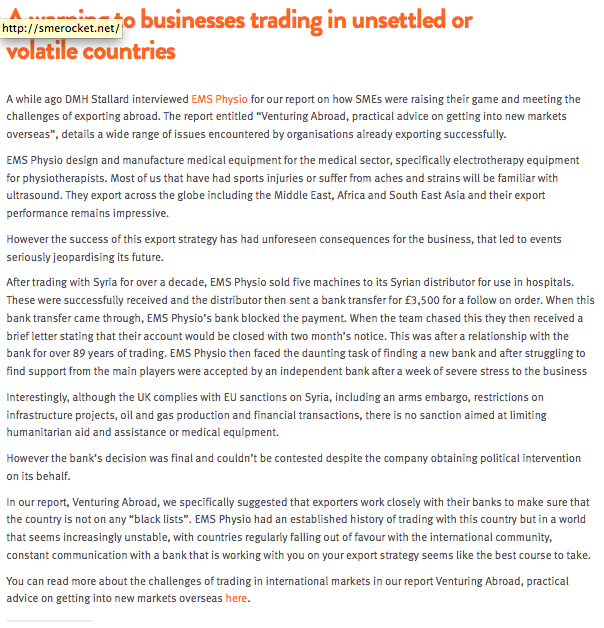
You can fine the full article here
http://smerocket.net/2014/08/11/exporting-volatile-countries/
Engaging with Generation Y
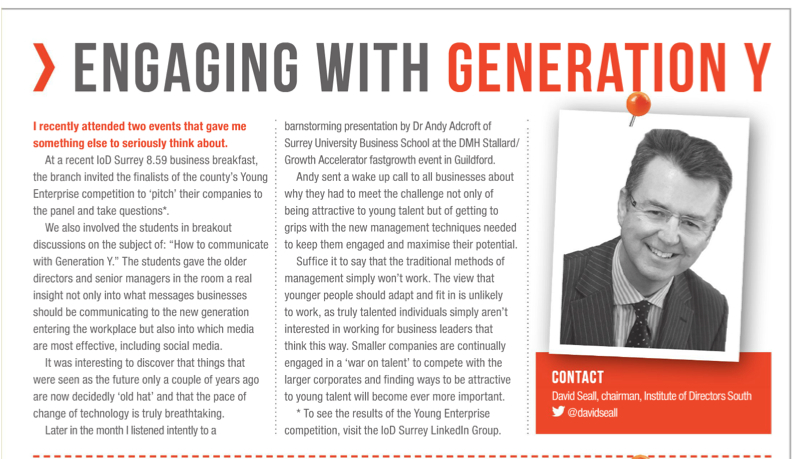
My latest article in South East Business Magazine
The article can be found here http://www.southeastbusiness.com/print-edition/august-2014

Recent Comments